


Generate £5 million/year with 13 people

Ali Abdaal is a doctor by training.
In 2017, he began publishing YouTube videos on productivity, learning, and content creation.
Today, he has over 6.5 million subscribers and his business generates £5 million per year, with 13 full-time employees.
His activity: content creator (YouTube, podcast, newsletter) + online training (Part-Time YouTuber Academy, his flagship course on creating YouTube channels).
Here's how his business is organized 👇
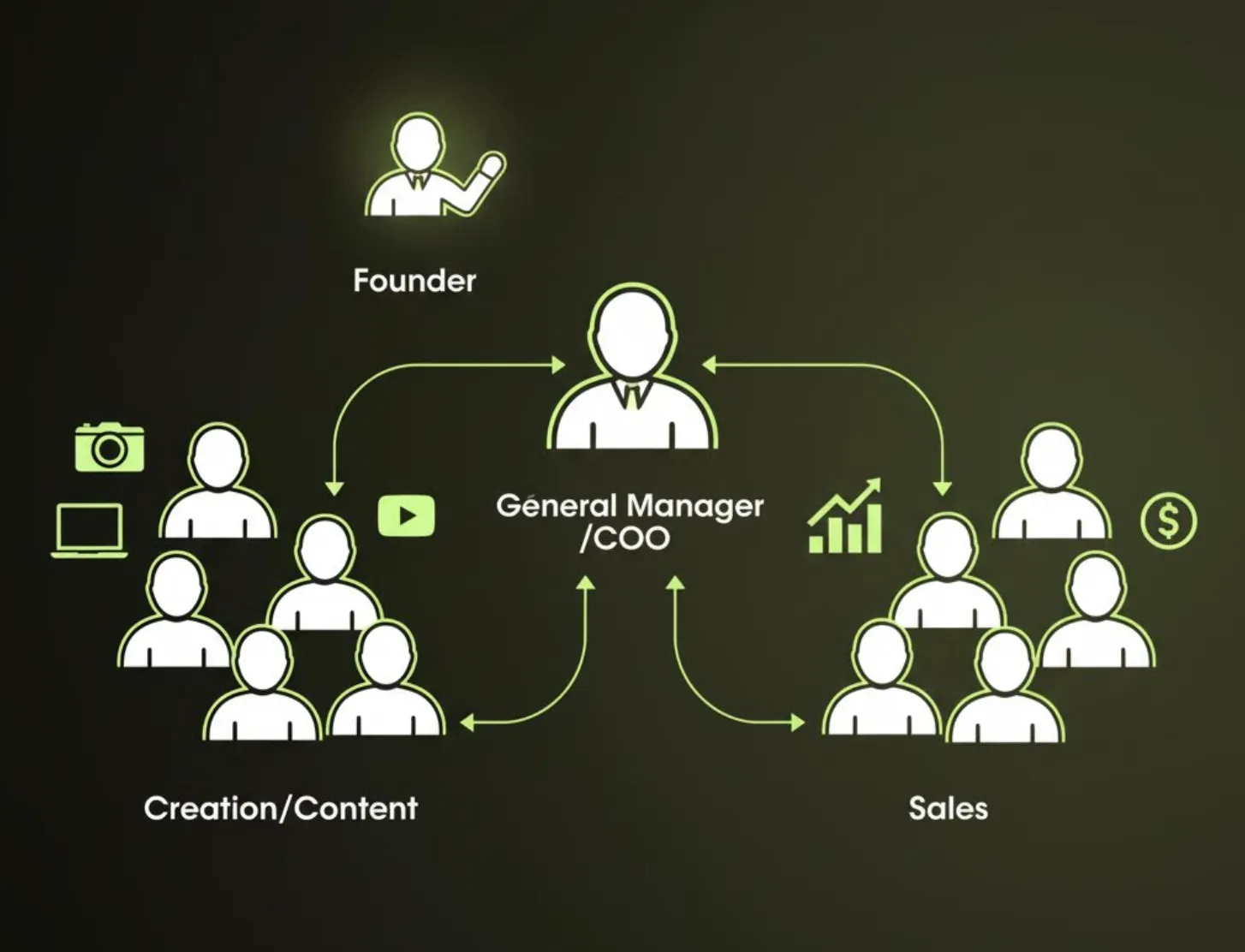
A simple and effective two-pronged structure
The organization is divided into two blocks:
- Content-wise (6-7 people)
- YouTube, podcasts, social media, websites, books.
- Revenue: AdSense + sponsorships → £1.5 to £2M/year.
- On the sales side (3-4 people + occasional freelancers)
- Primarily: Part-Time YouTuber Academy (the course).
- Revenue: £2-3M/year → 55-65% of total revenue.
Cross-functional areas (finance, sponsorships, operations) are managed by a single person: the General Manager.
The invisible role: the General Manager as COO
Angus Parker is 26 years old. He joined Ali as a freelance scriptwriter in 2020.
Today, he runs everything Ali doesn't do.
In concrete terms:
- He manages 10 people.
- He oversees the finances, without being the CFO.
- He manages partnerships, sponsors, and processes.
- He makes sure that everything is moving forward, all the time.
Ali creates. Angus makes it happen.
This isn't typical delegation. It's a clear separation between vision and execution . Without this key role, Ali would be stuck in day-to-day operations.
With it, he can launch new products, test, and explore. The business doesn't depend on Ali. It depends on a founder-integrator partnership .
The choices that enable profitability
1. Flat salary for the entire core team
Everyone with more than a year of service earns the same salary.
The result: a stronger team culture, less turnover, and more mutual support. It's a gamble. It only works if the team is cohesive and roles are clear.
2. Freelancers for all one-off projects
The course requires 8 to 10 people for 6 weeks to provide personalized feedback to students.
These individuals are not salaried employees. Given the cyclical nature of the activity (6-week cycle), they are freelancers recruited by cohort.
3. 6-week work sprints
The team does not work in 3-month quarters, it operates in 6-week cycles.
How it works:
- Week 1: The entire team meets in person to define the priorities for the next 6 weeks. Remotely, this might mean 1 to 2 days of video conferencing, with breaks, not to mention any client or operational projects that need to be addressed.
- Weeks 2 to 6: execution. Everyone knows what they have to deliver and by when.
- End of cycle: review, adjustments, new 6-week sprint.
Why 6 weeks, not 12?
Because beyond 6-8 weeks, we often lose track. Priorities change. The team drifts. Projects drag on.
4. A product that generates 60% of revenue
The course generates £2-3 million annually.
The remainder (YouTube, sponsorships, Skillshare) funds the free content.
The model is clear:
- Content feeds the audience.
- The course monetizes the audience.
- The course revenue funds the content.
No dependence on a single source. No fragmentation either.
What this says about profitability at this scale
A £5M business with 13 people generates £385,000 in revenue per person .
This makes it possible:
- A high margin product (online courses, B2B services).
- A small team, focused on the essentials.
- A founder who doesn't directly manage anyone.
- A General Manager or COO who absorbs all operational aspects.
- Intelligent outsourcing tailored to the seasonality of the business (freelancers, tools, ad-hoc agencies, accounting and legal services).
What prevents it for the leader:
- To be everywhere in the operational side.
- Acting in firefighter mode on a daily basis.
- To decide everything alone as the founder.
- Recruit instinctively as soon as there is a workload.
Questions to ask yourself
If your turnover exceeds €1 million and you have more than 10 employees:
→ Do you have someone who manages everything you don't manage yourself?
→ Do you know how much revenue each person on your team generates?
→ Are you recruiting because there's an overload of work, or because there's a key role to fill?
The difference between a profitable business and one that dilutes its margins is often this: in the revenue generated per person, not in the number of people.
To help you gain clarity, I've created a GPT that analyzes your team structure in 10 minutes — in relation to your current revenue and your objective. Take the diagnostic here .
Aurélie
%201.svg)

