


Freelance vs. Employee: The Calculation No One Makes

You spend 10 hours a week coordinating your freelancers.
You lose €135,000 per year due to turnover.
And you wonder why your profit margins aren't taking off.
Here's what nobody tells you about the real cost per head in a company between €1M and €5M.
At over €1M: the freelance model shows its limitations
At this stage, your business often looks like this:
- 2-3 people internally (including you)
- 5-10 regular or occasional freelancers
What a freelancer really costs
A freelancer charges an average of €450/day .
Over one month (20 days): €9,000 .
An employee at the same level:
- Net salary: €2,340
- Gross salary: €3,000
- Employer contributions (35%): €1,050
- Total cost: €4,650/month (including tools and benefits)
Freelancing costs twice as much on a daily basis.
But you tell yourself, "Yes, but I only pay when I need to."
The costs that nobody counts
1. Silent Turnover
A freelancer leaves without warning.
Consequences :
- You lose the continuity of know-how.
- You need to find, onboard, and brief a freelancer again.
- The quality of deliverables drops for a while. Not to mention the increased workload for you and your team.
2. Coordination time
10 freelancers = 5 to 10 hours per week to synchronize, validate, and follow up.
If your time is worth +€500/hour as a manager: €10,000 to €20,000 in hidden costs per month .
Over one year: €120,000 to €240,000 lost in coordination alone.
3. Memory loss
Generally, a freelancer doesn't document anything, isn't used to sharing information with other team members, and above all, doesn't train anyone on the team around them. There are, of course, exceptions when the freelancer has been with the company for a long time.
This means that with each departure, you risk starting from scratch by training new freelancers if they leave the company.
Beyond €1-2 million: costs skyrocket
1. Turnover is becoming a bottomless pit
The employee turnover rate in France: 15-16% .
But for freelancers? Easily 30 to 50% per year .
Why? Because they:
- They are leaving for a better mission;
- Become unavailable;
- They no longer suit your needs.
Out of 8-10 active freelancers: 3 to 5 replacements per year .
Replacing someone costs between 6 and 9 months' salary , sometimes up to 1 year .
For a profile at €45,000/year: €27,000 to €45,000 per replacement .
Over 3 to 5 departures: between €81,000 and €225,000 lost per year.
And again, this calculation does not include:
- The drop in productivity during the transition (30% over 2-3 months)
- The 90 days it takes for a new recruit to be at 100%
81% of employers still underestimate the impact of turnover .
2. Dependence on star freelancers
At over €1M in annual revenue, you often have 2-3 freelance critics on your biggest clients.
If one of them leaves, your turnover is directly threatened and you have little or no leverage to retain them.
3. When internalizing becomes profitable
One-year comparison:
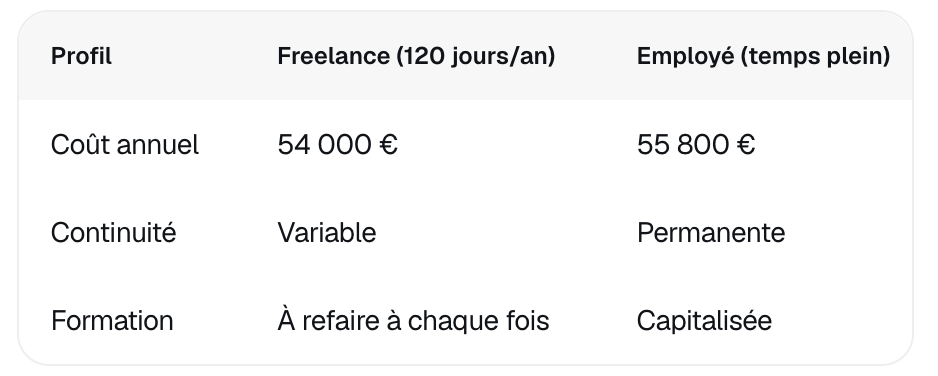
A freelancer working 50% of the time costs €54,000 per year , almost the same as a full-time employee.
But you won't have the continuity of expertise, the opportunity for professional development within the company, and also the loyalty.
So, to go from €1M to €2M, internalizing key functions = a lever for profitability.
4. The RPE: your health indicator
RPE (Revenue Per Employee) is the revenue generated per employee (or equivalent freelancer).
In general, successful agencies generate €150,000 to €200,000 in RPE (Revenue from Public Enterprises ).
Personnel costs must represent 50% of the AGI ( revenue excluding subcontracting).
If you rely too heavily on freelancers without a structure, your RPE collapses and your margins with it.
What needs to change after €1 million
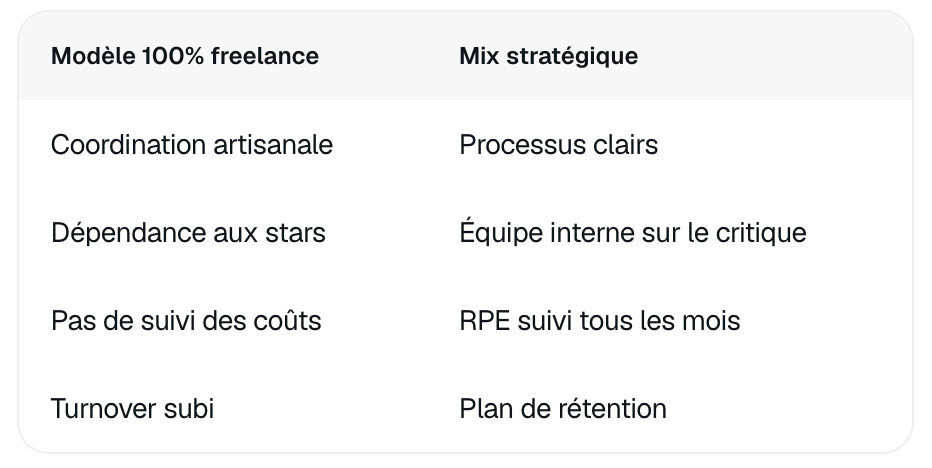
Key takeaways
The 100% freelance model works at the beginning.
But beyond €1-2M, it becomes a brake on growth.
Warning signs:
- You spend over 10 hours a week coordinating your army of freelancers.
- You lose key freelancers every year.
- Your RPE is stagnating below €150k.
And what about the AI agents in all of this?
You might be thinking, "AI agents will replace my army of freelancers."
Not so fast! AI agents can automate repetitive tasks (reporting, briefing, production monitoring).
But they do not replace:
- The strategic vision
- Customer relations
- Brand consistency
- The ability to adapt to the unexpected
AI is a tool, not a team. It can reduce your need for coordination and free up time, and above all, help your freelancers be more productive.
But it does not solve the underlying problem: dependence on volatile resources that are not aligned with your vision .
The real question
It's not "freelance or employee?"
Neither "AI nor human?"
It's: "What needs to be internalized, and when?"
The functions critical to your revenue and positioning must be internal.
The rest can be outsourced (or automated).
If you're still 100% freelance at +€3M, without structure and without automation, you easily leave €100-200k on the table every year .
Cheers and see you next week!
Aurélie
%201.svg)

