


Anatomy of a Business: The $1.5M+ Model Without a Team

Today I'm going to tell you the story of Justin Welsh, an American entrepreneur who generates over $1.5 million a year on his own.
Almost: he still has a virtual assistant 20 hours/week to answer customer emails.
On paper, his business model is a dream: 90% profit margin, no management, total freedom. Courses sold en masse at $150, a sponsored newsletter, and endlessly recycled content.
But behind this seemingly perfect machine lie costs that no one sees.
Costs that are not expressed in dollars (or euros), but in structure, vulnerability, and an invisible ceiling .
Let's go! Let's break down this model.
The model architecture
The main sources of income:
- Digital courses (LinkedIn OS, Content OS, Creator MBA): $1.3M/year
- Newsletter sponsorships: $150K/year
- Template subscriptions: $9/month × 1000 people
- Affiliate fee: $25K/year
The organization:
- 1 founder: Justin
- 1 VA at 20 hours/week: customer support only
- $650/month for automation tools
The production system:
- 1 newsletter per week → 10-20 derivative social posts → systematic reuse of high-performing content over 4 to 6 weeks.
- Everything is templated and standardized.
- And he applies the rule: nothing should be done twice. If it is, systems are put in place.
Invisible costs (those that no one calculates)
1. Total structural vulnerability
In 2021, Justin's LinkedIn profile disappeared for several hours. A technical glitch, but above all, a lot of panic.
His business relied entirely on this platform. No newsletter at the time. No other channels. If LinkedIn went down, everything would collapse.
The hidden cost: critical dependence on platforms like Facebook and LinkedIn, over which we have no control. Hence the importance of diversifying acquisition channels by including at least one social network and one newsletter.
He has since diversified (Twitter, newsletter), but the principle remains: his business is him .
- If he doesn't post, if he doesn't create, nothing happens.
- No system can generate revenue without it.
- No team to take over.
- No structure can survive its absence.
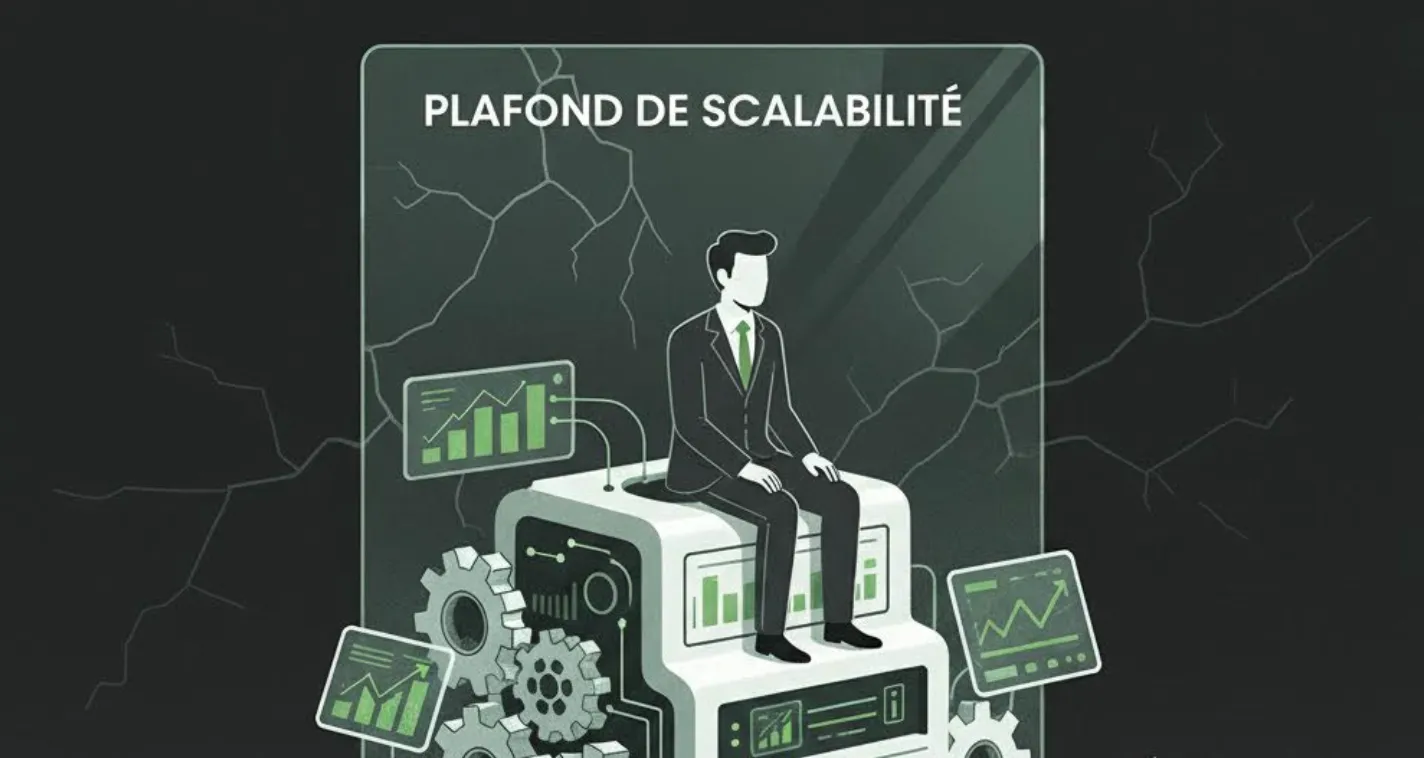
2. The scalability ceiling
- He cannot sell more than his audience absorbs.
- He can't launch 10 products simultaneously. He can't test new markets without diluting his personal brand.
The invisible cost: revenue is capped by the size of the audience and the market's absorption capacity.
To grow, it would have to change its model, certainly include paid marketing with ads, recruit, coordinate more service providers etc… but that would kill precisely what makes its business attractive: simplicity.
3. The hidden mental load
Justin has systems for everything. Templates, automations, a meticulously planned editorial calendar.
But these systems do not run on their own.
He is the one who:
- Decides on the newsletter topic each week
- Write the content (even with templates) and even with AI
- Performance analysis
- Adjust the strategy
- Maintains online presence
- Responds (indirectly via its VA) to dissatisfied customers
The invisible cost: a constant mental burden, knowing that everything rests on their shoulders. This requires a winning partnership with a CMO/marketing manager to delegate the editorial strategy, and a sparring partner such as a COO to reflect on the overall strategy and operationalize the CEO's vision.
4. The output value = zero
If Justin wants to sell his business tomorrow, how much is it worth?
Almost nothing.
Because the business is Justin . His face, his voice, his credibility. Without him, there is no product.
The invisible cost:
- Lack of heritage value
- Impossible to resell
- Everything stops when he stops.
What this teaches us (3 lessons for you)
1. A “teamless” model is not a cost-free model
The costs are not simply financial. They are structural, mental, strategic.
👉 Question to ask yourself: What hidden costs does your current model generate? Were you aware of them? Are you aligned with these costs?
2. Organizational simplicity comes at a price: the ceiling
The simpler a model is, the more its potential is capped. It's simple math.
👉 Question to ask yourself: Can your current model double without you doubling your working hours?
3. A profitable business is not always a solid business
- Profitability ≠ resilience.
- Profitability ≠ scalability.
- Profitability ≠ asset value.
Justin built the perfect tool... for himself. But it's not an asset. It's an income.
👉 Question to ask yourself: Would your business survive 6 months without you?
In conclusion
Justin Welsh's model is a masterclass in operational efficiency.
But it's also a gilded cage.
He traded the complexity of a team for total dependence on himself.
It's a choice that comes at a cost.
A cost that is not visible in the income. But which is still paid in terms of mental load, loneliness and dependence on oneself.
The real question is: what price are you willing to pay?
%201.svg)

