


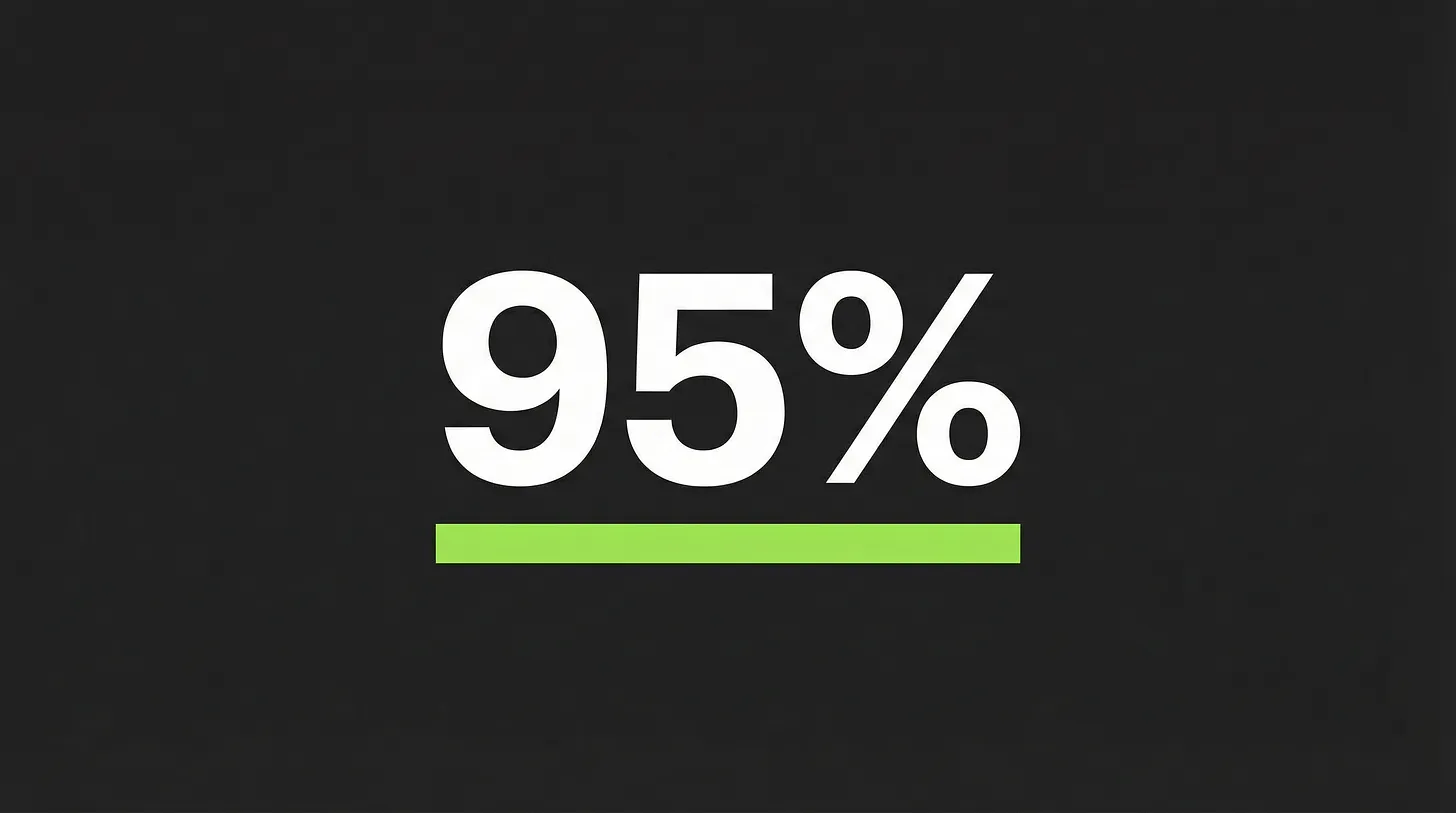
95% of AI deployed in SMEs failed by 2025. Here's why.

A painful figure.
According to an MIT report published in 2025, 95% of artificial intelligence initiatives launched in companies have not generated any measurable financial return.
Meanwhile, the promises continue and the media are in a frenzy: automation, time savings, cost reduction, job cuts.
But the reality is different.
AI doesn't eliminate jobs. It enhances your daily life.
AI does not eliminate work. It amplifies it.
Harvard Business Review published in February 2026 an 8-month study in a tech company of 200 people.
The employees used AI voluntarily. The results?
- Accelerated pace of work
- Expanded scope of tasks
- Extended working hours over more hours in the day
No manager had asked for this extra work. Employees did "more" simply because AI made "doing more" technically possible.
And one employee sums it up: “We thought that with AI, we would work less. But in fact, we work just as much. Or even more.”
AI has not freed up time.
Tasks have multiplied. Breaks have disappeared. Work has become permanent, fluid, invisible, and sometimes more tiring.
What the employment figures say
McKinsey surveyed nearly 2,000 organizations in 2025.
When asked about the expected impact of AI on their workforce in the coming year:
- 32% anticipate a reduction of 3% or more;
- 43% expect no change;
- 13% expect an increase.
In other words: no consensus .
- No massive wave of layoffs.
- No sudden transformation of the labor market.
But one thing is clear: most large companies hired AI professionals in 2025 (data engineers, software engineers). They added skills, not eliminated positions.
So why the 95% failure rate?
Because AI doesn't solve structural problems. It accelerates them.
The companies launched pilot programs without:
- Review their workflows
- Clarify the roles
- Form the teams
- Define expectations
The result: powerful tools placed on top of fuzzy processes.
AI has amplified the existing chaos. Faster. Stronger.
The 5% who succeed? They did the opposite. They redesigned their workflows before implementing AI. They defined clear rules. They trained their teams. They provided a framework.
What this changes for you
If you run an SME and are considering implementing AI, first ask yourself these questions:
- Are your processes clear?
If your teams don't know who decides what, AI isn't going to fix anything.
- Are your roles defined?
If everything goes through you, the AI will just make more things go through you.
- Are your workflows documented?
If no one knows how work flows, AI will just operate in the dark.
AI is not a problem. But it reveals everything that is malfunctioning in the organization and it intensifies it.
In summary
- AI does not lighten the load: it intensifies the pace, expands tasks, blurs the boundaries between work and life (HBR, 2026)
- To date, we have no evidence of mass job cuts apart from podcasts that are trending on Youtube and media outlets that are talking about a subject they don't understand.
- The 5% who succeed redesigned their processes before integrating AI.
AI doesn't replace your employees. It exposes your organization.
And if it is poorly structured, it accelerates your problems instead of solving them.
Cheers,
Aurélie
%201.svg)

