Blog · Sans moi, ça tourne ? (French newsletter)
Why the Hours You Save with AI Aren't Profitable
Manage AI like an investment: one process, a number before, a number after. A 5-step method to find out what AI really brings in.
October 24, 2026
59% of companies spend more than a million dollars a year on AI. Only 29% get a significant return from it. Those are the figures from Writer's 2026 survey, cited in a Forbes article on how companies measure AI.
Your SME isn't spending a million. But the question is the same: is what you pay for AI actually bringing you anything?
AI should be managed like an investment: you measure it by what it earns, not by the number of tools or people using it.
What the numbers show
- Writer's survey: many companies spend big, fewer than a third see a real return.
- PwC's global survey of 4,454 CEOs: only 12% see both higher revenue and lower costs thanks to AI.
- The US Chamber of Commerce Foundation survey, conducted with Ipsos among 750 small businesses: the ones that succeed don't spend more, they decide better. What makes the difference is having rethought the way they work.
It's not the tool that creates the gain. It's the process you cleaned up before plugging it in. AI equips a clear process; it doesn't make up for a fuzzy one.
A common case: 80% usage, zero return figures
Take a data consulting firm with 25 consultants. Profitable, fully booked, loyal key accounts. A year ago, the founder bought AI licenses for the whole team. Then a second tool for meeting notes. Then a third for sales proposals. Everyone uses them their own way.
In leadership meetings, the talk is about usage: "80% of the team uses it every week." But when asked "how much is it bringing us?", nobody can answer. Nobody measured how long a sales proposal took before. Nobody knows what happened to the hours saved.
An hour saved that is neither billed nor reinvested earns nothing. It just disappears.
Why we measure usage instead of results
- Usage is easy to count. Results require a baseline. If you don't know how long your monthly client reporting takes today, you'll never know what AI saved you.
- The tool was plugged into the process as it is, with its duplicates, its back-and-forth, its approvals that all go back through you. AI moves faster down a crooked path. The path stays crooked.
- Nobody owns the result. Licenses are a line in overhead, tied to no offer and no margin.
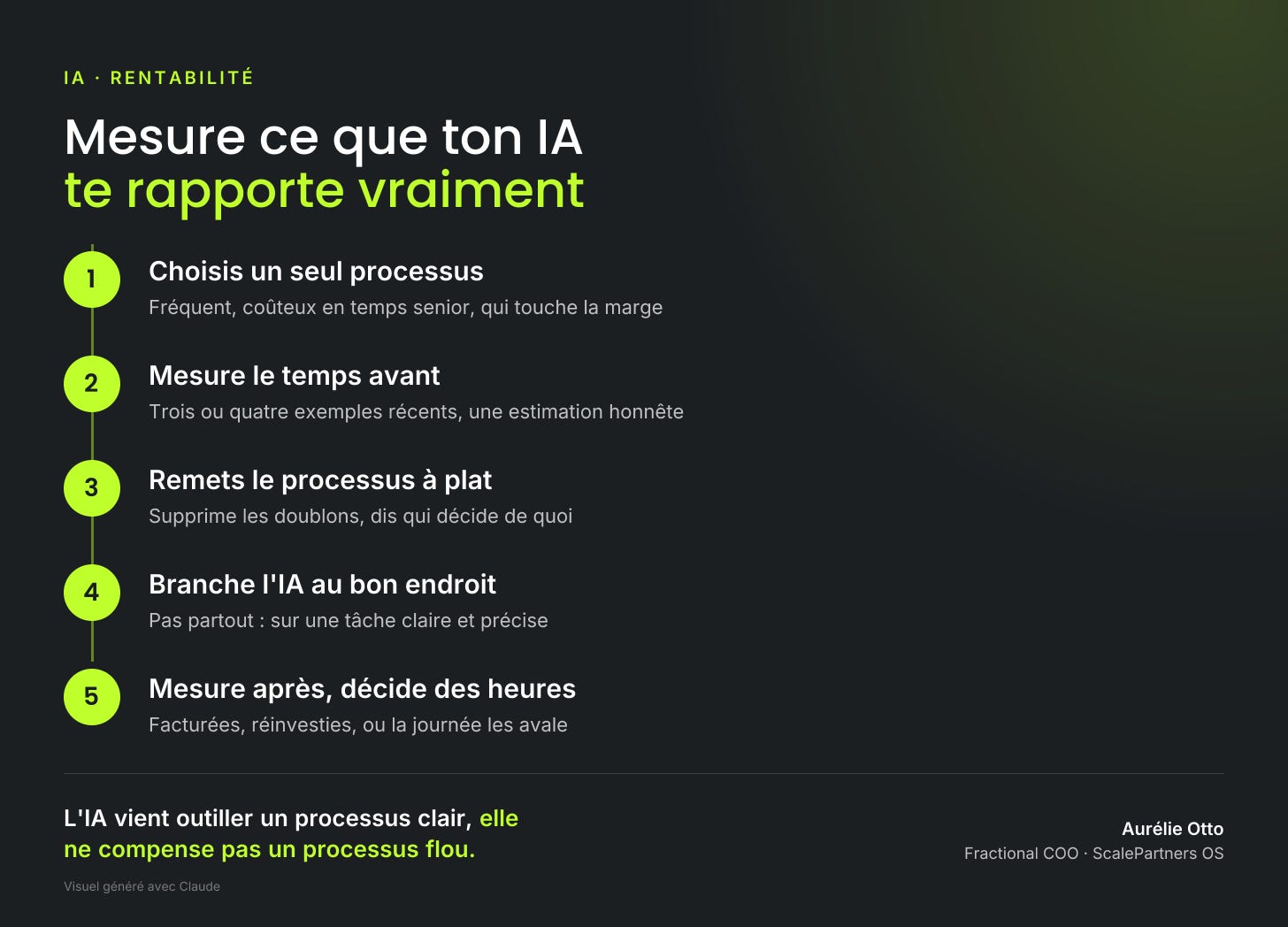
The method: one process, a number before, a number after
- Pick a single process. One that comes up often, eats senior consultant time and affects margin: sales proposals, recurring deliverables, client reporting, preparing leadership meetings.
- Measure before. How long it takes, who's involved, how many rounds of back-and-forth: an honest estimate on three or four recent examples is enough.
- Clean up the process. What can be removed, who decides what, what doesn't need to go back through you? That's often where half the gain is made, even before AI.
- Plug AI in at the exact step where it helps. Not everywhere: where it saves time on a clear task.
- Measure after, and decide where the hours go. Billable work, business development, a new offer? If you don't decide, the day swallows them up.
Not every gain is counted in hours: fewer errors in a deliverable, a shorter response time, a consultant who's less underwater. But it can be described in black and white, with a before and an after. Otherwise, it's just an impression.
What you can do this week
- List everything you pay for in AI: subscriptions, licenses, tools added by the team. Write down the total monthly cost.
- Pick one process and measure it as it is over the last three examples: hours, people, back-and-forth.
- Ask your leadership team one question: not "who's using AI?" but "what did it bring us this quarter, in hours or in euros?"
- Add one line to your dashboard: hours saved on this process, and what became of them, updated once a month.
To go further: the simulator "What AI really earns your firm, in euros" (in French).
Cleaning up processes before plugging AI into them is part of my work as a Fractional COO for B2B service SMEs.
This article is adapted from the October 24, 2026 issue of my French newsletter Sans moi, ça tourne ?