Blog · Sans moi, ça tourne ? (French newsletter)
AI Doesn't Create Margin. The Way You Sell Does.
AI saves time, but your billing model decides whether it turns into margin. 3 market figures and a 4-step checklist.
October 3, 2026
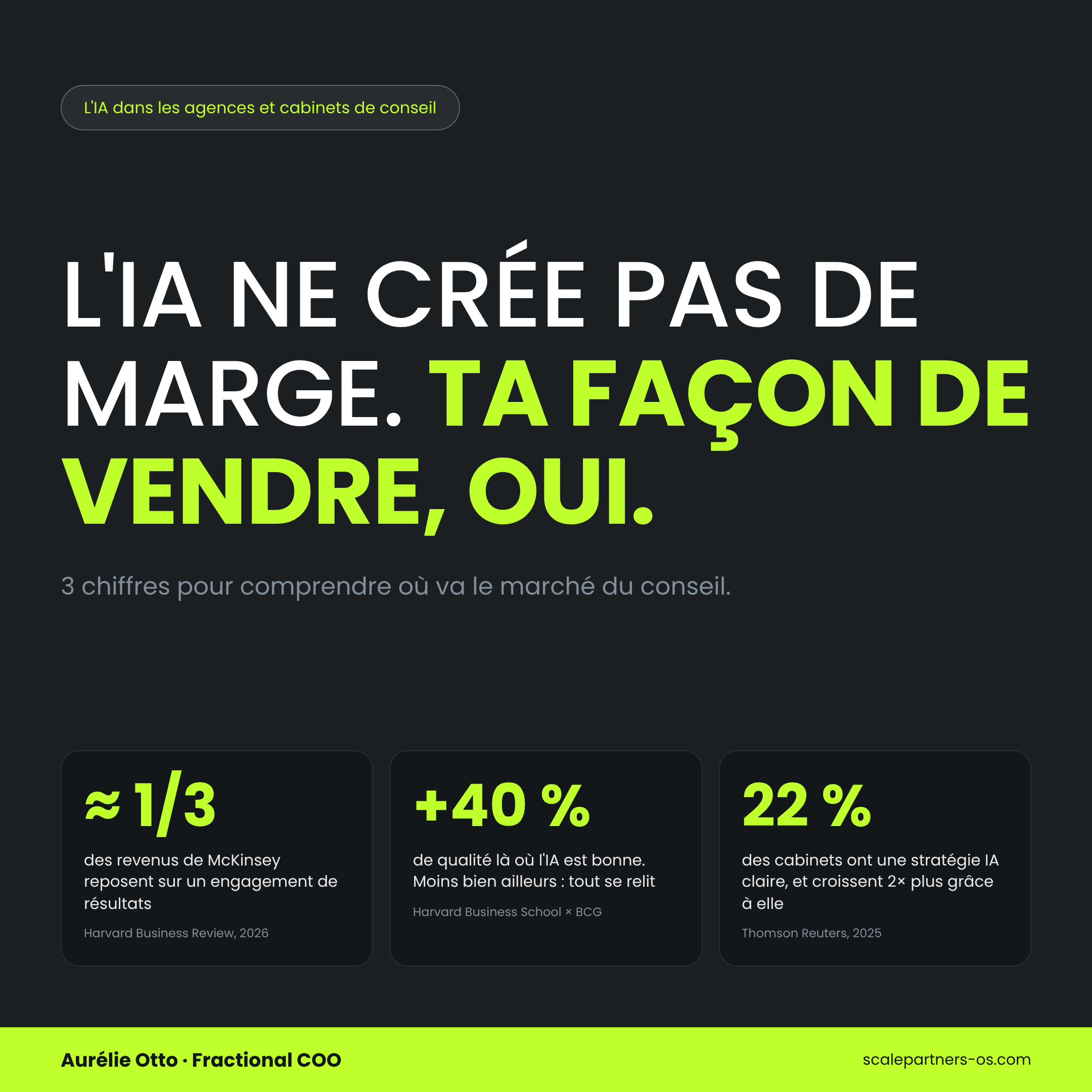
AI isn't a miracle tool. What matters is what it changes in the way an agency or consulting firm produces and sells its work.
"We've been using AI for over a year without being able to measure the gains"
I work with a consulting firm of about twenty consultants. When I arrived, AI was "already rolled out": subscriptions for the whole team, an ambitious launch of a cross-functional AI project. Six months later, everyone was using it on their own, nothing was shared, nothing was measured. And the margin hadn't moved.
The reason is simple: the firm bills by the day. When your consultants work faster and you sell time, either you bill less, or the time saved evaporates into polishing and unbilled requests. It's almost always the second option.
AI only creates margin if something changes in the way you sell.
3 figures that show where the B2B market is heading
- About a third. That's the share of McKinsey's revenue that now relies on outcome-based engagements, according to its managing partner Bob Sternfels (Harvard Business Review, January 2026). Stanford researchers describe the emerging model: a fixed monthly or annual fee, plus a component tied to results.
- +40% quality, but not everywhere. Harvard Business School and BCG tested AI with 758 consultants. On tasks where AI is good, quality rises by more than 40%. On the others, consultants using AI get it wrong more often. The gain depends on knowing where to use it, and on reviewing the output.
- 22%. That's the share of professional firms (legal, audit, tax, compliance) with a clear AI strategy, according to Thomson Reuters. Those firms are twice as likely to see AI grow their revenue. It's not the tool that makes the difference, it's the organization built around it.
The checklist: 4 steps, under 2 hours
- Pick the task that costs you the most (30 min). With your team, list the tasks that come back every week: meeting notes, sales proposals, client reporting, follow-ups. Keep just one: the one that eats the most hours and doesn't involve sensitive data.
- Find the test owner (30 min). Ask the team who already uses an AI tool for that task, and how much time it saves. The most comfortable person becomes the test owner. According to Microsoft and LinkedIn (2024), 78% of employees who use AI do so with their own tools, without a company framework.
- Run a 2-week test with clear rules (30 min). Five shared lines: what can go into the tool; what never goes into it (client names, confidential figures, personal data); everything AI produces gets reviewed; who to ask when in doubt; the tool to use, the one you're already paying for. Measure the time without AI, then with it, over at least three occurrences, and schedule the review right away.
- Decide in advance where the time saved will go (30 min). Bill differently (turn the service into a fixed fee), reinvest it with the client in something they'll notice, or free up capacity to take on one more client without hiring.
In a nutshell
AI alone doesn't make an agency more profitable. It saves time, and it's your billing model that decides whether that time becomes margin or disappears. You don't need to be McKinsey to sell results instead of days: you just need to ask yourself what your clients are really buying.
Integrating AI into processes and reworking the offer that goes with it is part of my work as a Fractional COO for B2B service SMEs.
This article is adapted from the October 3, 2026 issue of my French newsletter Sans moi, ça tourne ?